目录 16 个小节
前言对编译过程的简单概括词法分析实现过程语法分析实现过程语义分析实现过程中间代码生成实现过程目标代码生成实现过程一些其他内容(优化等等)对于语法分析过程中的优化目标代码优化过程中的优化结语记录一下编译器的简单开发
本文主要是记录个人PL0编译器的开发过程,面向开发的对编译过程的一次梳理,并且进行记录,如果有理解不到位的地方,还希望大家指出(我编译原理可菜了)
对于文中不严谨的地方,还望大家评论指出
前言
全文概览:
对编译过程的简单概括
编译过程,在我看来就是将A代码转换成B代码的一个过程,在主流的场景下,A代码可以是一些高级计算机语言,比如JS、Java等等;B代码则更多是低级别代码语言,比如机器码、汇编、WASM等。这项差别也直接说明了编译的目标————将人类可读的代码转换成机器可=8读的代码。
整个完整的编译过程主要有六步:
- 词法分析
- 语法分析
- 语义分析
- 中间代码生成
- 目标代码优化
- 目标代码生成
不过在我开发过程中,对于其中的第五步“目标代码优化”穿插在了中间代码生成和目标代码生成中,而不是单独拎出来进行处理的,因此我的开发模块主要是开发了另外五步,接下来我将简单介绍我对每一个编译模块开发的实践和理解:
词法分析
对于我的词法分析器lexicalAnalysis,主要是读取前端发来的代码文本(字符串),移除空白和注释,然后基于pl0的语法将文本内容分解成一个个token,最终获取token stream用于后续语法分析等流程。
实现过程
初始化tokens用于以此保存所有token,初始化cur指针,用于依次处理每个char,并且利用正则来进行不同类型的char的识别,例如
// 空格
const isWhitespace = (char) => /\s/.test(char);
// 字母
const isLetter = (char) => /[a-zA-Z]/.test(char);
// 数字
const isDigit = (char) => /\d/.test(char);
//...等等处理其他类型的char
这里需要注意,对于一些双符号操作符或者变量,可能需要利用nextChar来进行处理或者利用多次循环的拼接来处理,
对于遍历完毕之后,规范上需要添加一个"EOF"来标识终结符,告知语法分析器结束,实现如下:
// EOF表示终止符
tokens.push({ type: "EOF", value: null, line: currentLine });
至此,最终能够获取最后的tokens,用于后续的语法分析,格式如下(示例):
"LexicalAnalysis": [
            {
                "type": "Keyword",
                "value": "var",
                "line": 1
            },
            {
                "type": "Identifier",
                "value": "x",
                "line": 1
            },
            {
                "type": "Semicolon",
                "value": ";",
                "line": 1
            },
            {
                "type": "Keyword",
                "value": "begin",
                "line": 2
            },
            {
                "type": "Identifier",
                "value": "x",
                "line": 3
            },
            ...,
            {
                "type": "End",
                "value": ".",
                "line": 22
            },
            {
                "type": "EOF",
                "value": null,
                "line": 22
            }
        ]
语法分析
实现过程
对于我的语法分析器syntaxAnalysis,主要是根据词法分析的产物tokens(token stream)构建AST,结合了递归下降分析实现的,在开发语法分析器的时候,要结合pl0的文法规则(语法规则),对token逐一进行处理;在这个过程中,如果遇到语法错误,编译器需要报告错误,并终止编译过程;据我的体验,语法分析应该是整个编译过程中最难写的了,十分繁琐,这可能需要结合对应的文法规则,实现如下:
初始化的时候,需要初始化curIndex用于追踪当前处理到的token,同时需要初始化一个SymbolTable用于追踪变量和方法(在pl0称为procedure)。
接下来需要处理几个核心方法
- analyze:入口方法,初始化tokens,进行处理,并返回ast;
- match:核心方法,用于匹配当前token是否和期望类型或者值匹配,匹配则前进一个curIndex,否则抛出异常;
  // 匹配
match(expectedType, expectedValue = null) {
  if (this.currentToken && this.currentToken.type === expectedType) {
    // 如果提供了expectedValue,则还需要匹配token的具体值
    if (expectedValue !== null && this.currentToken.value !== expectedValue) {
      throw new Error(
        `Expected token value ${expectedValue}, but found ${this.currentToken.value}`
      );
    }
    this.advance();
  } else {
    // 抛出错误时,包含更多关于期望和实际的信息
    const foundType = this.currentToken ? this.currentToken.type : "EOF";
    const foundValue = this.currentToken ? this.currentToken.value : "None";
    throw new Error(
      `Expected token type ${expectedType}${
        expectedValue ? " with value " + expectedValue : ""
      }, but found type ${foundType} with value ${foundValue}`
    );
  }
},
- peek:预测下一个token的值,通常用于避免回溯,进行优化;
- advance:curIndex++,移动指针;
- program:解析tokens的核心文件,是整个ast的根节点,用于在最外层遍历token,一旦识别到EOF,则退出循环,结束遍历;
program() {
    const nodes = [];
    // 判断是否到了最后一个标签
    while (this.currentToken && this.currentToken.type !== "EOF") {
      nodes.push(this.block());

      if (this.currentToken && this.currentToken.value === ".") {
        // 匹配`end`
        this.advance();
      }
    }
    return {
      type: "Program",
      children: nodes,
      line: this.currentToken.line,
    };
  },
- block:对一个代码块上下文的处理,有两部分,一个是声明阶段(非必要),一个是语句处理(相对必要);
- declaration:声明阶段,主要是对pl0的“var”和“const”声明的内容进行初始化和追踪;
- statement:对于其他语句的处理,首先要判断是单词还是关键字,分别对不同类型进行处理,如果是单词,则是过程的声明或者调用,并对不同情况进行处理;如果是关键字,则需要利用Switch对不同类型的语句进行特殊处理,处理内容如下:
- if/while/for/call/read/write等语句的处理
// 对几个比较负责的语句处理进行展示(for和if)
//for循环的处理
forStatement() {
    this.match("Keyword", "for"); //for循环处理
    const variableName = this.currentToken.value;
    const forLine = this.currentToken.line;
    this.match("Identifier");
    this.match("Equals", ":=");
    const initialValue = this.expression(); // 匹配for初始化的表达式
    this.match("Keyword", "to"); //
    const finalValue = this.expression(); //
    this.match("Keyword", "do"); //
    let loopBody = null;
    if (this.currentToken.value === "begin") {
      // 如果循环体以 'begin' 开始,则预期是多条语句
      loopBody = this.beginEndStatement(); // 解析 begin...end 结构
      this.match("Semicolon");
    } else {
      // 否则,解析单条语句作为循环体
      loopBody = this.statement(); // 解析单条语句
      this.match("Semicolon", ";");
    }

    // ;
    this.match("Keyword", "end");
    this.match("Semicolon", ";");
    return {
      type: "ForStatement",
      variableName: variableName,
      initialValue: initialValue,
      finalValue: finalValue,
      body: loopBody,
      line: forLine,
    };
  },
// if语句的处理,重点在于if-elseif-...-else语句的递归处理
  ifStatement() {
    this.match("Keyword", "if"); // 匹配 'if'
    const condition = this.expression(); // 解析条件表达式
    this.match("Keyword", "then"); // 匹配 'then'
    const ifLine = this.currentToken.line;
    let thenStatement = null;
    // 直接检查下一个token,决定是解析单条语句还是多条语句
    if (this.currentToken.value === "begin") {
      // 如果是begin,则预期为多条语句,使用beginEndStatement解析
      thenStatement = this.beginEndStatement();
      this.match("Semicolon");
    } else {
      // 否则,解析单条语句
      // thenStatement = this.parseSingleStatement();
      thenStatement = this.statement();
      // this.match("Semicolon");
    }
    let elseStatement = null;
    const elseIfStatements = [];
    while (this.currentToken.value === "else") {
      this.match("Keyword", "else");
      if (this.currentToken.value === "if") {
        this.match("Keyword", "if");
        const elseifCondition = this.expression();
        this.match("Keyword", "then");
        if (this.currentToken.value === "begin") {
          // 如果是begin,则预期为多条语句,使用beginEndStatement解析
          const elseifThenStatement = this.beginEndStatement();
          this.match("Semicolon");
          elseIfStatements.push({
            condition: elseifCondition,
            thenStatement: elseifThenStatement,
          });
        } else {
          // 否则,解析单条语句
          // thenStatement = this.parseSingleStatement();
          const elseifThenStatement = this.statement();
          // this.match("Semicolon");
          elseIfStatements.push({
            condition: elseifCondition,
            thenStatement: elseifThenStatement,
          });
        }
        // this.match("Semicolon");
      } else {
        if (this.currentToken.value === "begin") {
          elseStatement = this.beginEndStatement();
          this.match("Semicolon");
        } else {
          elseStatement = this.statement();
          // this.match("Semicolon");
        }
      }
    }
    this.match("Keyword", "end");
    this.match("Semicolon");
    return {
      type: "IfStatement",
      condition: condition,
      thenStatement: thenStatement,
      elseIfStatement: elseIfStatements,
      elseStatement: elseStatement,
      line: ifLine,
    };
  },
- parse:主要是一些对变量或者过程名的处理;
- 对于变量声明或赋值、过程调用等语句的解析
- expression:算术表达式的处理,有几个核心方法,但是是按照已有的顺序进行处理,避免出现左递归问题;
- 解析顺序控制————大小比较、加减法、乘除法、因子处理
 // 逻辑表达式的解析
  expression() {
    let left = this.arithmeticExpression(); // 首先解析算术表达式
    while (
      this.currentToken &&
      ["<", "<=", "=", "<>", ">", ">="].includes(this.currentToken.value)
    ) {
      const operator = this.currentToken.value;
      const line = this.currentToken.line;
      this.match("Operator"); // 匹配比较操作符
      let right = this.arithmeticExpression(); // 再次解析算术表达式作为右侧
      // 构建比较表达式的AST节点
      left = {
        type: "BinaryExpression",
        operator: operator,
        left: left,
        right: right,
        line: line,
      };
    }
    return left;
  },
  // 计算解析(加减法)
  arithmeticExpression() {
    let node = this.term();
    while (this.currentToken && ["+", "-"].includes(this.currentToken.value)) {
      const operator = this.currentToken.value;
      const line = this.currentToken.line;
      this.match("Operator", operator); // 匹配加减运算符
      const right = this.term(); // 解析右侧的term
      node = {
        type: "BinaryExpression",
        operator: operator,
        left: node,
        right: right,
        line: line,
      };
    }
    return node;
  },
  // 计算解析(乘除法)
  term() {
    let node = this.factor();
    while (this.currentToken && ["*", "/"].includes(this.currentToken.value)) {
      const operator = this.currentToken.value;
      const line = this.currentToken.line;
      this.match("Operator", operator); // 匹配乘除运算符
      const right = this.factor(); // 解析右侧的factor
      node = {
        type: "BinaryExpression",
        operator: operator,
        left: node,
        right: right,
        line: line,
      };
    }
    return node;
  },
  // 因子解析
  factor() {
    // 这个方法需要解析数字和括号内的表达式
    if (this.currentToken.type === "Number") {
      const node = {
        type: "Literal",
        value: this.currentToken.value,
        line: this.currentToken.line,
      };
      this.advance(); // 前进到下一个token
      return node;
    } else if (this.currentToken.type === "Identifier") {
      const node = {
        type: "Identifier",
        name: this.currentToken.value,
        line: this.currentToken.line,
      };
      this.advance(); // 前进到下一个token
      return node;
    } else if (this.currentToken.value === "(") {
      this.match("Operator", "("); // 匹配左括号
      let node = this.expression(); // 解析括号内的表达式
      this.match("Operator", ")"); // 匹配右括号
      return node;
    }
    throw new Error(`Unexpected token: ${this.currentToken.value}`);
  },
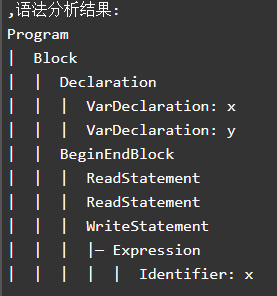
通过上述的几个核心方法,语法分析器会在调用analyze(tokens)的时候,执行一系列方法,依次读取tokens,并构建AST,JSON格式如下:
"SyntaxAnalysis": {
            "type": "Program",
            "children": [
                {
                    "type": "Block",
                    "children": [
                        {
                            "type": "Declaration",
                            "children": [
                                {
                                    "type": "VarDeclaration",
                                    "name": "x",
                                    "line": 1
                                },
                                {
                                    "type": "VarDeclaration",
                                    "name": "y",
                                    "line": 1
                                }
                            ],
                            "line": 3
                        },
                        {
                            "type": "BeginEndBlock",
                            "statements": [
                                {
                                    "type": "ReadStatement",
                                    "variableName": "x",
                                    "line": 4
                                },
                                {
                                    "type": "ReadStatement",
                                    "variableName": "y",
                                    "line": 5
                                },
                                {
                                    "type": "WriteStatement",
                                    "expression": {
                                        "type": "Identifier",
                                        "name": "x",
                                        "line": 6
                                    },
                                    "line": 6
                                }
                            ],
                            "line": 4
                        }
                    ],
                    "line": 7
                }
            ],
            "line": 7
        }
经过加工后的前端显示格式如下:
语义分析
实现过程
对于我的语义分析器semanticAnalysis,要根据AST以及追踪生成一个有意义的符号表,用于检查变量的声明和使用、过程的声明和调用、算术表达式的使用是否有意义,同时遍历不同Statement的节点(if、for)来追踪变量的使用;受限于pl0语法的限制,我简化了这一分析器,因为pl0里主要是在全局进行变量的声明,而不需要对每一个上下文进行处理。实现如下:
初始化的时候,需要初始化curIndex用于追踪当前处理到的token,同时需要初始化一个SymbolTable用于追踪变量和方法(在pl0称为procedure)。
接下来需要处理几个核心方法
- analyze:入口方法,初始化SymbolTable,执行节点的遍历,返回值为符号表;
- init:初始化一个SymbolTable,记录符号表;
- processNode:对不同类型节点的处理,Switch去调用不同的详细处理方法,比如子节点的处理、变量的处理、Statement语句的遍历等;
- processChildren&&processStatement:对于block类型和Statement类型的结构的处理,因为他们可能包含多个子节点,利用forEach进行遍历执行;
- processDeclaration等追踪变量以及过程名的方法:核心内容,结合SymbolTable,检查语义是否异常,实现如下:
// 变量声明
  processDeclaration(node) {
    node.children.forEach((decl) => {
      const name = decl.name;
      if (this.symbolTable[name]) {
        throw new Error(`Variable ${name} is already declared.`);
      }
      this.symbolTable[name] = { type: decl.type, value: null }; // 声明变量,默认值为null
    });
  },
  // 过程声明
  processProcedureDeclaration(node) {
    const name = node.name;
    if (this.symbolTable[name]) {
      throw new Error(`Procedure ${name} is already declared.`);
    }
    this.symbolTable[name] = {
      type: "Procedure",
      parameters: [],
      body: node.body,
    };
    // 这里可以递归分析过程体,以处理局部变量等
  },

  processAssignmentStatement(node) {
    const name = node.identifier;
    if (!this.symbolTable[name]) {
      throw new Error(`Variable ${name} is not declared.`);
    }
    // 这里可以对赋值表达式进行分析,暂略
  },
  // 过程调用
  processProcedureCall(node) {
    const name = node.name;
    if (
      !this.symbolTable[name] ||
      this.symbolTable[name].type !== "Procedure"
    ) {
      throw new Error(`Procedure ${name} is not declared.`);
    }
    // 对过程调用进行分析,这里简化处理,实际中可能需要检查参数
  },
总体来说,语义分析主要是对于SymbolTable的构建,利用SymbolTable检查代码是否存在语义上的歧义,同时生成的符号表也可以为后续调试等功能提供相应数据,其大概格式为:
"SemanticAnalysis": {
            "x": {
                "type": "VarDeclaration",
                "value": null
            },
            "y": {
                "type": "VarDeclaration",
                "value": null
            }
        }
后续可能会利用符号表提取常量和变量的数据,做一些二次处理,这些会在后面的调试器内容中提到;
中间代码生成
实现过程
对于我的中间代码生成器intermediateCodeGeneration,是基于语法分析器的产物AST开始处理的,整体其实也是利用DFS进行对AST的遍历处理。生成实现如下:
这里主要是一个核心方法,利用深度优先遍历的方式从根节点出发,直到遍历到叶子结点,对叶子结点进行对应的中间代码生成,核心片段代码展示(省略了一些语句的处理,只是用于展示说明):
// 对每个节点的处理操作
switch (node.type) {
      case "Program":
      // 对非叶子节点的处理
      case "Block":
        node.children?.forEach((child) =>
          this.generateCodeFromNode(child, intermediateCode)
        );
        break;

      case "BeginEndBlock":
        node.statements.forEach((statement) =>
          this.generateCodeFromNode(statement, intermediateCode)
        );
        break;
      // 对于声明语句的处理
      case "Declaration":
        node.children.forEach((decl) => {
          const code =
            decl.type === "VarDeclaration"
              ? `DECLARE ${decl.name}`
              : `CONST ${decl.name} = ${decl.value}`;
          intermediateCode.push({ code, line: decl.line });
        });
        break;
      // 赋值处理
      case "AssignmentStatement":
        this.generateCodeFromNode(node.expression, intermediateCode); // 先处理表达式
        intermediateCode.push({
          code: `STORE ${node.identifier}`,
          line: node.line,
        });
        break;
      // 过程调用
      case "ProcedureCall":
        intermediateCode.push({ code: `CALL ${node.name}`, line: node.line });
        break;
      // if语句处理
      case "IfStatement":
        this.generateCodeFromNode(node.condition, intermediateCode);
        intermediateCode.push({ code: "IF", line: node.line });
        this.generateCodeFromNode(node.thenStatement, intermediateCode);
        if (node.elseIfStatement) {
          node.elseIfStatement.forEach((elseif) => {
            this.generateCodeFromNode(elseif.condition, intermediateCode);
            // console.log(elseif);
            intermediateCode.push({
              code: "ELSEIF",
              line: elseif.condition.line,
            });
            this.generateCodeFromNode(elseif.thenStatement, intermediateCode);
          });
        }
        if (node.elseStatement) {
          intermediateCode.push({
            code: "ELSE",
            line: node.elseStatement.line,
          });
          this.generateCodeFromNode(node.elseStatement, intermediateCode);
        }
        intermediateCode.push({ code: "ENDIF", line: node.line }); // 可能需要调整行号
        break;
      // for循环语句的处理
      case "ForStatement":
        this.generateCodeFromNode(node.initialValue, intermediateCode);
        intermediateCode.push({
          code: `FOR ${node.variableName} INIT`,
          line: node.line,
        });
        this.generateCodeFromNode(node.finalValue, intermediateCode);
        intermediateCode.push({
          code: `FOR ${node.variableName} TO`,
          line: node.line,
        });
        this.generateCodeFromNode(node.body, intermediateCode);
        intermediateCode.push({
          code: `ENDFOR ${node.variableName}`,
          line: node.line,
        });
        break;
      // 算术表达式的处理
      case "BinaryExpression":
        this.generateCodeFromNode(node.left, intermediateCode);
        this.generateCodeFromNode(node.right, intermediateCode);
        intermediateCode.push({
          code: `OPER ${node.operator}`,
          line: node.line,
        });
        break;

      case "Literal":
        intermediateCode.push({ code: `PUSH ${node.value}`, line: node.line });
        break;

      case "Identifier":
        intermediateCode.push({ code: `LOAD ${node.name}`, line: node.line });
        break;

      default:
        console.warn(`Unhandled node type: ${node.type}`);
    }
中间代码生成器在根据AST生成中间代码的过程的同时,也会同时携带对应的line,便于在目标代码生成的时候携带line,用于pl0代码和目标代码的映射处理;上述代码段只显示了部分语句的处理,由于篇幅限制,并没有提供完整代码,中间代码的格式在前端的显示效果如下(for循环示例):
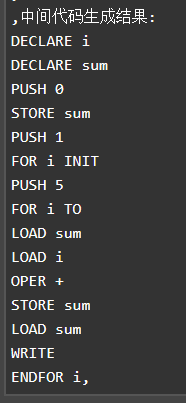
生成中间代码之后,可以进行最后的目标代码生成处理。
目标代码生成
实现过程
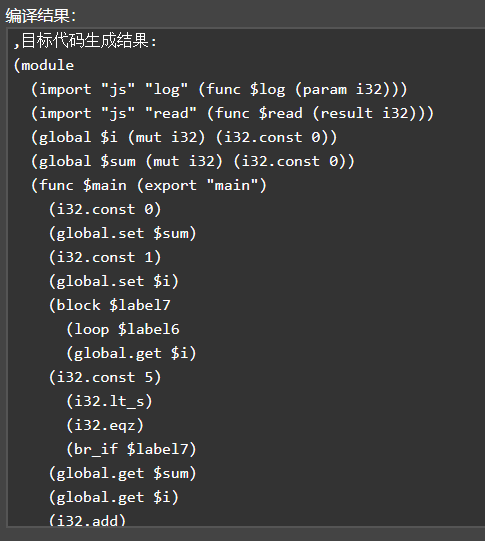
对于我的目标代码生成器targetCodeGeneration,我主要是设计了两个版本,因为一开始了解到WASM在web端执行效率高,所以一开始的目标代码为WAT(WASM的文本格式,WASM本身是二进制格式,过于抽象);但是受限于WASM执行无法中断的特点,我又新增了一个目标代码为JS的格式,用于前端方便的实现中断、继续、调试等功能。由于JS可读性更好,所以我这边展示的代码片段主要是JS生成器的代码片段,实现如下:
初始化阶段,需要初始化的内容主要有以下几个内容:
- variableDeclarations:主要是用于实现类似符号表的功能,避免出现重复声明的问题,使用的Set数据结构进行存储;
- varStack:利用栈的结构调用变量,由于中间代码有store和load两个处理,所以在使用一个变量的时候可能要进行入栈和出栈操作;
- loopLabelsStack:对循环语句的记录,主要是判断是否是在循环语句之中;
- conditionStack:主要是对于WASM模式下的if-elseif-else的处理;
- functionsCode:生成的目标代码的最终文本格式;
在生成的过程中,对于每个中间代码行进行解构操作,例如const [operation, operand1, operand2] = code.split(" ");,从而获取对应的指令和一些参数(operand可能为undefined),从而利用Switch语句对每个operation进行判断处理,执行一些对应的操作,其中,对于算术表达式、if语句等等语句需要进行特殊处理,核心代码片段展示如下:
//对于算术表达式的处理
  handleOperation(operation, left, right) {
    const operatorMappings = {
      "+": `${left} + ${right}`,
      "-": `${left} - ${right}`,
      "*": `${left} * ${right}`,
      "/": `${left} / ${right}`,
      ">": `${left} > ${right}`,
      "<": `${left} < ${right}`,
      "=": `${left} == ${right}`,
      // Add more operators as needed
    };
    // console.log(operation);
    // console.log(operatorMappings);
    return operatorMappings[operation];
  },
// 对于一些条件语句的处理(js的相对简单,WASM需要利用conditionStack来控制结束)
  handleCondition(operation, operand1, operand2, line) {
    switch (operation) {
      case "IF":
        const conditionIf = this.varStack.pop();
        return `if (${conditionIf}) {//${line}\n`;
      case "ELSEIF":
        const conditionElseIf = this.varStack.pop();
        return `} else if (${conditionElseIf}) {//${line}\n`;
      case "ELSE":
        return `} else {//${line}\n`;
      case "ENDIF":
        return `}//${line}\n`;
      default:
        return "// Unhandled condition\n";
    }
  },
// 循环语句处理
  handleLoop(operation, operand1, operand2, line) {
    switch (operation) {
      case "WHILE":
        return `while (`;
      case "DO":
        const result = this.varStack.pop();
        // DO logic here if your intermediate code requires it
        return `${result}){//${line}\n`;
      case "ENDWHILE":
        return `}//${line}\n`;
      case "FOR":
        if (operand2 === "INIT") {
          return `for (${operand1} = 0;${operand1} < `;
        } else if (operand2 === "TO") {
          return `${this.varStack.pop()};${operand1}++){//${line}\n`;
        }
      // Assuming FOR loop structure is defined in your intermediate code
      // return `for (let ${operand1} = 0; ${operand1} < ${operand2}; ${operand1}++) {\n`;
      case "ENDFOR":
        return `}//${line}\n`;
      default:
        return "// Unhandled loop\n";
    }
  },
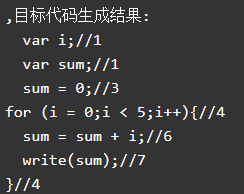
对于目标代码的生成,我还在每一行进行了注释添加,注释后面添加的内容是当前js行对应的pl0源代码的行数,实现一种简单的映射,便于前端用户的查看,同时也方面后续调试功能的映射处理。目标代码在前端的展示效果如下,对于同一段代码的解析,JS格式如下:
一些其他内容(优化等等)
对于语法分析过程中的优化
- 左递归问题:本身我的pl0语法规则不包含显示的左递归的,左递归通常发生在类似
A->Aa | b的规则中,这种情况下会导致语法分析会进入无线递归中。而我的语法分析基于递归下降分析实现的,并且利用引入了不同优先级的非终结符来间接处理; - 回溯问题:在处理具有相同前缀的token的时候,可能会陷入回溯问题,我通过引入
peek()方法,对curToken的下一个token进行预测,在一定程度上避免了这种问题; - 错误处理:主要是利用match机制,对于不符合预期的,即不符合语法规则的错误进行抛出,能够更好的济宁错误处理,不过可以继续优化,比如跳过一些token直到遇到一个已知的“安全点”等;
- SymbolTable的引入:通过利用符号表,对一些变量的声明检查进行管理,虽然pl0本身可能比较简单,用不到作用域管理,但是这种思想是必要的;
目标代码优化过程中的优化
- 变量声明优化:变量在使用前都进行声明,避免了变量提升的问题;
- 表达式的处理、过程的调用:都利用了JS的机制进行优化,比如表达式的四则运算直接换成了JS的等效操作、call利用了JS的内联函数调用和尾调用优化;
- 条件和循环控制结构的优化:同样的,也是利用了JS或者WASM的等效结构,也利用了对应的优化机制;
结语

本人可能对一些编译原理更复杂的知识(例如语法分析的其他方式等)掌握的依旧不是很好,但是我希望这是一个新的起点,自己日后也会多加学习,而不是对于开发语言的浅尝辄止。
本文如果有不严谨的地方,还请各位在评论区指出!
COMMENTS · 4
想超市小魏
杜杜宝宝521
楼上别太离谱,我应该引入一个文本检查过滤机制了
提倡言论自由 不搞文字狱